The AI Visibility Tool Bubble: $1B Valuations, $29/mo Competitors, and Zero Moats
An 18-month-old AI visibility startup just raised at $1B — while its own data supplier trades at $158M. Here's what the valuation gap reveals about the AEO tool market.

The AI Visibility Tool Bubble: $1B Valuations, $29/mo Competitors, and Zero Moats
We searched “best AI visibility tracking tools” in ChatGPT, Perplexity, and Claude last week. The company that just raised $96 million at a $1 billion valuation to help brands monitor their AI search visibility — Profound — wasn't cited in any of them.
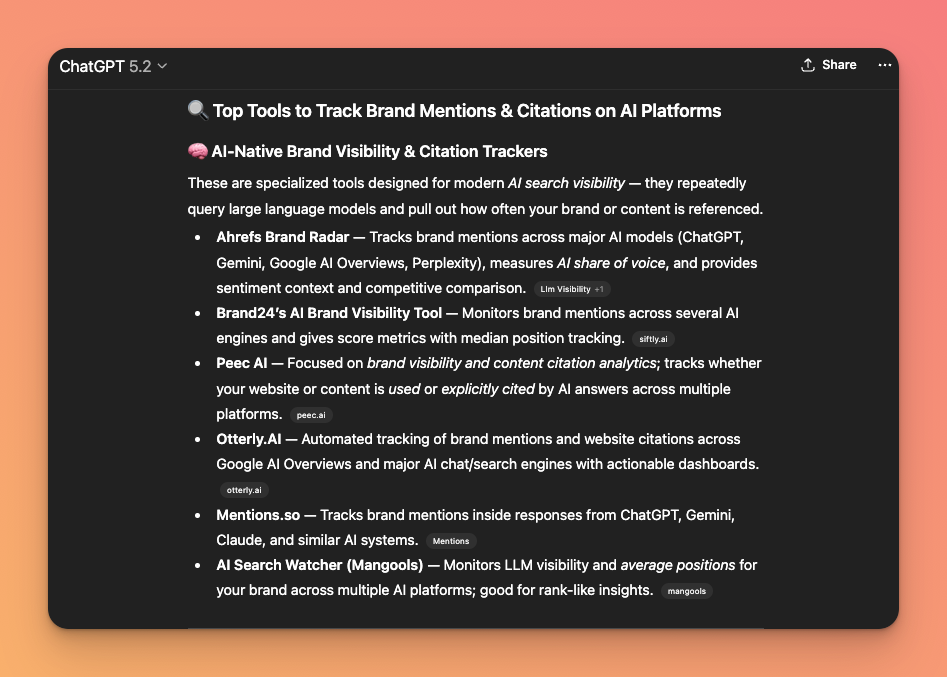
An AI visibility company that AI search can't find. That's either irony or a data point. We think it's both.
We build AEO optimization services for B2B SaaS companies. We have free tools on this site that check AI citation readiness. We're practitioners in this market, not spectators. And when we looked at the numbers behind Profound's headline valuation — the competitive landscape, the data licensing structure, the gap between what VCs are pricing and what the public markets are pricing — we found a story worth telling. Not because Profound is a bad company. They're not. But because the math reveals something important about how the entire AI tooling market is being valued right now.
The short version: Profound's $1B valuation reflects VC category excitement, not market fundamentals. The company licenses its data from providers worth a fraction of its own valuation, competes with 20+ tools offering near-identical features, and isn't visible in the AI search results it helps brands monitor. None of this means the problem is fake — brands absolutely need AI visibility intelligence. But the gap between tool valuations and tool outcomes has never been wider. Tools don't own outcomes. Strategy, content architecture, and the humans running them do.
$1B
Profound Series C valuation at 18 months old
GlobeNewswire, Feb 2026
$283M
Similarweb trailing 12-month revenue (public company)
NYSE: SMWB
20+
AI visibility tools competing for the same market
AirOps, Peec AI, Otterly, Scrunch, + more
The Valuation That Made Us Do a Double-Take
Ahrefs CMO Tim Soulo posted a comparison on LinkedIn that stopped us mid-scroll:
“So Profound was valued at $1B... while Similarweb is valued at just ~$158M ($229.58M market cap minus $72M in cash). Make it make sense.”
Soulo runs marketing for Ahrefs — a competitor to both companies — so he has a clear angle. But the numbers don't need editorial spin. Let's lay them out.
Similarweb is a publicly traded company (NYSE: SMWB) with $283 million in trailing annual revenue, proprietary data collected through a global panel of millions of opted-in users, direct measurement partnerships, and five years of operating history as a public company. Analysts rate it a “strong buy” with a $14.89 average price target — implying the market thinks it's worth roughly double its current price.
Profound was founded in 2024 by James Cadwallader and Dylan Babbs at South Park Commons. In 18 months, it has raised $155 million across four rounds — seed ($3.5M), Series A ($20M), Series B ($35M in August 2025), and Series C ($96M in February 2026, led by Lightspeed with Sequoia and Kleiner Perkins following). It does not publish revenue figures. It serves 700+ enterprise customers, including 10% of the Fortune 500.
The inversion: a company that licenses data from Similarweb is valued at roughly 6x more than Similarweb itself.
This isn't a hit piece on Profound. Enterprise sales execution that lands Target, Walmart, Figma, and MongoDB in 18 months is genuinely impressive. But the gap between these two valuations tells a story about how VCs are pricing AI companies right now — and it's a story every team buying AEO tools should understand.
The Data Licensing Problem Nobody Mentions
Here's the structural question that doesn't appear in any of the funding announcements: Profound does not collect its own data.
The platform monitors how brands appear across AI assistants like ChatGPT, Gemini, and Perplexity. To do this, it licenses clickstream and behavioral data from established providers — including Similarweb and Datos (a Semrush subsidiary). This data comes from browser extensions, consented panels, app telemetry, and provider networks. It's anonymized, aggregated, and compliant with GDPR and CCPA.
This is a common model in SaaS. Plenty of successful companies are built on licensed data. But it creates a specific vulnerability when your data suppliers are also entering your market.
Ahrefs launched custom AI prompt tracking in January 2026. Semrush now has an AI Visibility Index. Similarweb added a Gen-AI Intelligence module. The incumbents — the same companies that supply the underlying data — aren't sitting still. They're building the same monitoring capabilities directly into platforms that millions of SEO professionals already use.
The question isn't whether Profound has a good product. It's whether a $1 billion valuation is defensible when your core input is rented, your suppliers are becoming competitors, and the switching cost for customers is low.
Twenty Tools, One Feature Set
Soulo named the competitive landscape in his post: “AirOps, Peec AI, Scrunch, Otterly, Promptwatch, UseHall, LLMrefs, LLMpulse, Promptingcompany, Xfunnel, Evertune... and many-many more.”
He wasn't exaggerating. We mapped the current AI visibility tool market and found 20+ platforms competing on substantially similar feature sets.
| Tool | Founded/Status | Funding | Starting Price | Platforms Tracked | Differentiator |
|---|---|---|---|---|---|
| Profound | 2024 | $155M+ | Enterprise | ChatGPT, Gemini, Perplexity | AI marketing agents, Fortune 500 clients |
| AirOps | Funded | $40M+ | Enterprise | Multiple platforms | Content automation workflows |
| Semrush | Public (NYSE) | N/A | $139/mo+ | AI Overviews, ChatGPT, Perplexity | Integrated into existing SEO suite |
| Ahrefs | Bootstrapped | $0 | $129/mo+ | Custom AI prompts (Jan 2026) | Integrated into existing SEO suite |
| Peec AI | Germany | €7M | €89/mo | ChatGPT, Perplexity, AI Overviews | Multi-language support |
| Otterly | Gartner Cool Vendor | Undisclosed | $29/mo | ChatGPT, Perplexity, Gemini, Claude, AI Overviews | Broadest platform coverage at lowest price |
| XFunnel | Active | Undisclosed | Varies | ChatGPT, Perplexity, Claude, Gemini, AI Overviews | Real-time monitoring + recommendations |
| Evertune | Active | Undisclosed | Varies | Multiple platforms | Sentiment + competitor benchmarks |
| LLMrefs | Active | Undisclosed | Varies | ChatGPT, Perplexity | Keyword-based AI visibility pioneer |
| SE Visible | Active | Undisclosed | Varies | ChatGPT, Perplexity, AI Mode, Gemini | Accuracy + UX focus |
The pattern is clear: multi-platform tracking, sentiment analysis, competitor benchmarking, and citation monitoring are table-stakes features that nearly every tool in this market offers. The core functionality is converging.
Otterly tracks five AI platforms for $29 per month. Profound serves similar functions at enterprise pricing. The question every buyer should ask: what are you getting for the 10x-50x price difference? If the answer is “enterprise sales support and a nicer dashboard,” that's a packaging moat, not a technology moat.
When 20+ companies offer near-identical products, the market is commoditizing in real time. And commodity markets don't support $1 billion valuations for long.
Credit Where It's Due: What Profound Gets Right
Fair analysis requires acknowledging what's working. Several things are.
Enterprise traction is real. Seven hundred enterprise customers in 18 months, including 10% of the Fortune 500, is not accidental. Landing Target, Walmart, Figma, MongoDB, Ramp, U.S. Bank, and Chime requires serious go-to-market execution — especially in a category most enterprises are still learning about.
The research is valuable. Profound's 10-million-search study on AI platform citation patterns produced genuinely useful findings: Wikipedia tops ChatGPT citations at 7.8%, Reddit leads for both Google AI Overviews (2.2%) and Perplexity (6.6%), and commercial domains account for 80%+ of citations. This is original data that advances the industry's understanding.
The problem is real. Brands need to know how they appear in AI search. The adoption data makes the channel impossible to ignore: 38% of software buyers start their search with AI chatbots (Gartner, 2026), and $750 billion in US revenue is projected to funnel through AI-powered search by 2028 (McKinsey, 2025). AI visibility monitoring solves a legitimate problem.
The platform play goes beyond tracking. Profound has expanded beyond simple monitoring into AI marketing agents — content agents, PR agents, AEO agents that monitor signals, generate content, and adjust strategy. If the vision is a full marketing command center for the AI era, the valuation may be pricing in the platform, not just the tracking tool.
Maybe VCs are right that the platform play justifies the premium. But platform potential and platform reality are different things, and right now the competitive moat around the core product is thin.
The VC Due Diligence Question
Profound's valuation doesn't exist in a vacuum. It's part of a broader pattern in AI funding.
AI startups raised $80.1 billion in Q1 2025 alone — 70% of all venture capital activity. That created 498 AI unicorns valued at a combined $2.7 trillion. Those are staggering numbers, and they raise an uncomfortable question: is this price discovery, or is it a bidding war between VCs competing to own AI categories regardless of unit economics?
CNBC reported that companies are privately admitting concerns about “vibe revenue” — valuations divorced from fundamentals. MIT's NANDA initiative found that 95% of generative AI pilots at companies are failing to move beyond pilot stage. And the Builder.ai collapse showed that even major investors can miss fundamental business problems when narrative overpowers analysis.
“Profound: $1B valuation. 18 months old. No public revenue. Licensed data. 20+ direct competitors. Category excitement drives pricing.”
Valuation based on category potential and growth narrative
“Similarweb: ~$158M enterprise value. $283M annual revenue. Proprietary data. Public market scrutiny. Established moat. Fundamentals drive pricing.”
Valuation based on actual revenue, margins, and competitive position
Then there's the specific irony we opened with: an AI visibility company that isn't visible in AI search. When we searched for “AI visibility tracking tools” across ChatGPT, Perplexity, and Claude, Profound didn't show up. Their enterprise customers probably don't find them through AI search — they find them through sales outreach, conferences, and referrals. That's fine for an enterprise go-to-market strategy. But it does raise a question: if your own product category can't demonstrate its value on itself, what does that signal about the category's maturity?
Does raising $155 million in 18 months prove product-market fit? Or does it prove that VCs are competing with each other to fund anything with “AI” in the pitch deck?
We don't claim to know the answer. But we think the question is worth asking out loud.
Tools Don't Own Outcomes
Here's the contrarian position we'll stake: the tool is 10% of the outcome. The strategy, content architecture, and humans running the program are the other 90%.
This is the Pipeline Gap applied to AEO tooling. Just as most SEO agencies for B2B SaaS report traffic instead of pipeline — measuring activity instead of outcomes — most AEO tools report visibility scores instead of business results. A dashboard showing your “AI visibility score” is not the same as actually getting cited more often. The gap between measurement and outcome is where all the value lives. And no tool, regardless of its valuation, closes that gap on its own.
We covered the technical reasons why AI visibility tracking has inherent limitations in our deep-dive on the non-determinism problem. The short version: LLM outputs vary run-to-run, citation results are probabilistic, and no tool can give you a stable “ranking” in AI search. That's the technical constraint.
The market constraint is different: even if the tracking were perfect, monitoring alone doesn't improve your citation probability. Knowing you're not being cited is step one. Changing your content architecture, schema implementation, and entity signals so you start getting cited — that's where results come from.
A $50K/year visibility dashboard that tells you “your brand was mentioned 12% of the time for this query” is useless without the strategic layer that answers: why 12%, not 40%? What structural changes would increase citation probability? Which platforms matter most for your buyers? What content format does each platform prefer to cite?
The tool tells you the score. Strategy changes the score. Those are different skills, and conflating them is how teams waste budget.
Entity Audit
Understand how AI platforms currently see (or miss) your brand
Content Architecture
Structure content for citation probability — not just search rankings
Schema & Technical Foundation
Implement the structured data that helps AI understand your entity
Strategic Optimization
Content changes driven by citation gap analysis, not dashboard metrics
Monitoring
The tool goes here — last, not first. Track trends after the work is done.
The order matters. Most teams buy the monitoring tool first and do the strategic work never. That's like buying a scale before you've decided to change your diet. The measurement isn't the intervention.
For teams serious about ranking in AI search, the tool is the last step in a five-step process, not the first. And the right tool might be the $29/month option that gives you directional data — not the enterprise platform that gives you a fancier way to see the same directional data.
What Teams Should Actually Do
If you're a B2B SaaS company evaluating AEO tools, here's the honest advice:
Start with free tools. Run a free AEO citation readiness check to understand whether your content is structurally prepared for AI citations. If your content isn't citation-ready, no monitoring tool will help — you're tracking a problem without fixing it.
Do the foundational work first. Entity audits, content restructuring, schema implementation, and strategic content creation. These are the interventions that actually change citation probability. Do this before spending on monitoring.
Evaluate tools on actionability. When you're ready for a monitoring tool, evaluate on one dimension: does it tell you what to change, or just what the score is? A tool that shows you your visibility percentage without actionable recommendations is a scoreboard, not a coach.
Consider whether incumbents are enough. Ahrefs and Semrush are both adding AI visibility features to platforms you may already pay for. If your SEO strategy for B2B SaaS already runs on one of these tools, the incremental AI features may be sufficient — especially if you're in the early stages of AEO.
Be skeptical of enterprise pricing for commodity features. If a $29/month tool tracks the same platforms and provides directional data, the burden of proof is on the $50K/year tool to show what the premium buys beyond packaging.
Frequently Asked Questions
Is Profound a scam?
No. Profound is a real company with a real product, real enterprise customers (700+, including Fortune 500 names), and real original research. The question isn't whether the product works — it's whether the $1B valuation reflects market fundamentals or VC category enthusiasm. Those are different questions.
Should I use an AI visibility tracking tool?
Yes, but after you've done the foundational AEO work — not before. Monitoring citation probability is useful directional intelligence. But buying a monitoring tool before restructuring your content for citations is measuring a problem without fixing it. Do the entity audit, content restructuring, and schema implementation first. Then add monitoring to track the results.
Is the AI visibility tool market a bubble?
Twenty-plus competitors offering near-identical features, a $1B valuation on a company with licensed data and 18 months of history, and commodity pricing starting at $29/month — these signals suggest the market is overvalued relative to its defensibility. Whether that corrects through consolidation, feature commoditization, or a funding winter remains to be seen.
What's the best AEO tool for B2B SaaS?
It depends on your stage. For readiness assessment: free tools like citation readiness checkers. For directional monitoring on a budget: Otterly ($29/mo) or Peec AI (€89/mo) cover the major platforms. For teams already running Ahrefs or Semrush: their built-in AI features may be sufficient. Enterprise-grade platforms like Profound make sense only if you're running a dedicated AEO program at scale and need the agent-based automation layer.
Does this mean AI visibility doesn't matter?
The opposite. AI visibility matters enormously — 38% of software buyers start their search with AI chatbots, and that number is climbing. The problem isn't the category. The problem is the assumption that a tool alone drives outcomes. Tools measure. Humans and strategy drive results.
This post is a companion to our technical analysis of AI visibility measurement: Is AI Visibility Tracking a Scam? The Non-Determinism Problem Nobody Talks About. That post covers why LLM outputs vary run-to-run. This one covers why the market economics don't add up.
If you want to move beyond dashboards to actual citation outcomes — content architecture, entity optimization, and schema implementation that changes how AI platforms see your brand — that's what we build.
Founder, XEO.works
Ankur Shrestha is the founder of XEO.works, a cross-engine optimization agency for B2B SaaS companies in fintech, healthtech, and other regulated verticals. With experience across YMYL industries including financial services compliance (PCI DSS, SOX) and healthcare data governance (HIPAA, HITECH), he builds SEO + AEO content engines that tie content to pipeline — not just traffic.